Most generative speech enhancement methods rely on explicit time-step embeddings for temporal conditioning. In this paper, we propose the Autonomous Rectified Flow framework, which challenges the necessity of such conditioning. Using a linear interpolation path, we show that the target vector field is inherently time-invariant. We further introduce a time-unconditional network that eliminates explicit time-step information and infers the denoising direction solely from the spatial relationship between the current state and the noisy observation. Predicting this target vector field is equivalent to modeling the noise distribution. By avoiding overfitting to temporal trajectories, the proposed autonomous design significantly improves generation quality, robustness, and inference efficiency.
The proposed framework is evaluated on the VoiceBank+DEMAND dataset.
Listen and compare the speech quality under different models and inference steps (NFE).
| Sample ID | Noisy | Clean | FLOWSE (Baseline) | ARFSE (Proposed) | ||
|---|---|---|---|---|---|---|
| NFE = 1 | NFE = 5 | NFE = 1 | NFE = 5 | |||
| p232_250 | ||||||
| p232_409 | ||||||
| p257_008 | ||||||
| p257_033 | ||||||
| p257_106 | ||||||
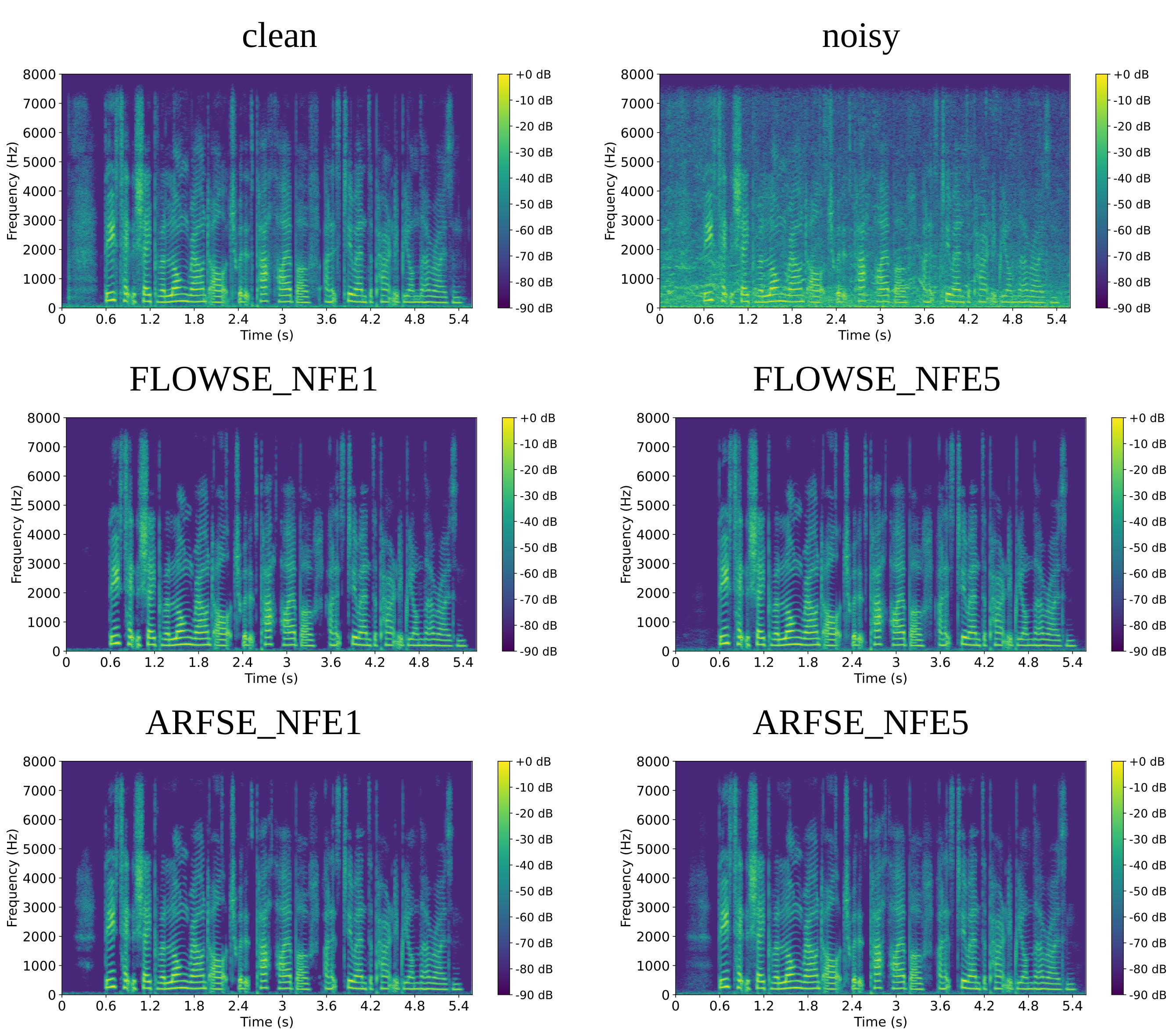
Visual comparison of spectrogram recovery across FLOWSE baseline and our proposed ARFSE framework.